
Mender
Something breaks: a cup, a body, a habit, a trust, a line in the fabric of a day. The Mender does not rush to declare it ruined. The first movement is quieter: get close enough to understand where the break is, how it happened, and what kind of repair would actually hold.
This archetype is not about dramatic rescue. It is the person who notices the fracture, studies the stress around it, and looks for the clean repair. The work may be physical, relational, practical, or embodied, but the gesture is the same: damage is information, not the end of the story.
The Mender
Section titled “The Mender”The Mender is the archetype of trustworthy repair. Its center of gravity is hands-on restoration: sensing what has come loose, finding the hidden point of strain, and making the fix strong enough to be lived with again.
The tone is simple: the person who keeps the cracked chair in use by tightening one hidden screw before anyone asks. It is not performative care. It is attentive, exacting, and close to the material.
Mender often works through touch before theory. The hands notice what the explanation has not yet caught. The repair is not just a solution placed on top of the break; it comes from contact with the break itself.
Nature Ingredients
Section titled “Nature Ingredients”These are the plain-language ingredients behind the type. They are included for orientation, not as technical scoring.
- Healing Nature: the pull toward restoration, recovery, and making damaged things usable again.
- Fine Bodily Intelligence: the hand skill for small, exact adjustments.
- Naturalistic Intelligence: sensitivity to material, body, texture, growth, strain, and repair.
- Intrapersonal Intelligence: the quiet steadiness needed when repair takes time.
Card Universe: Threader
Section titled “Card Universe: Threader”
In the card-universe experiments, Mender becomes Threader: a repair figure of the Verdant Current, working with thread, cloth, vessel, fracture, hand tools, and a sheltered green room. The image language is deliberately low to the ground. No beams of magic, no spectacle, no heroic pose. The power is in attention.
The draft card fragments say:
The hands know before the instruments.
Quiet repairs last longest.
The fracture speaks through touch.
Those lines are not meant as supernatural claims. They point to a behavioral pattern: the Mender trusts close contact, patient sensing, and the slow intelligence of repair.
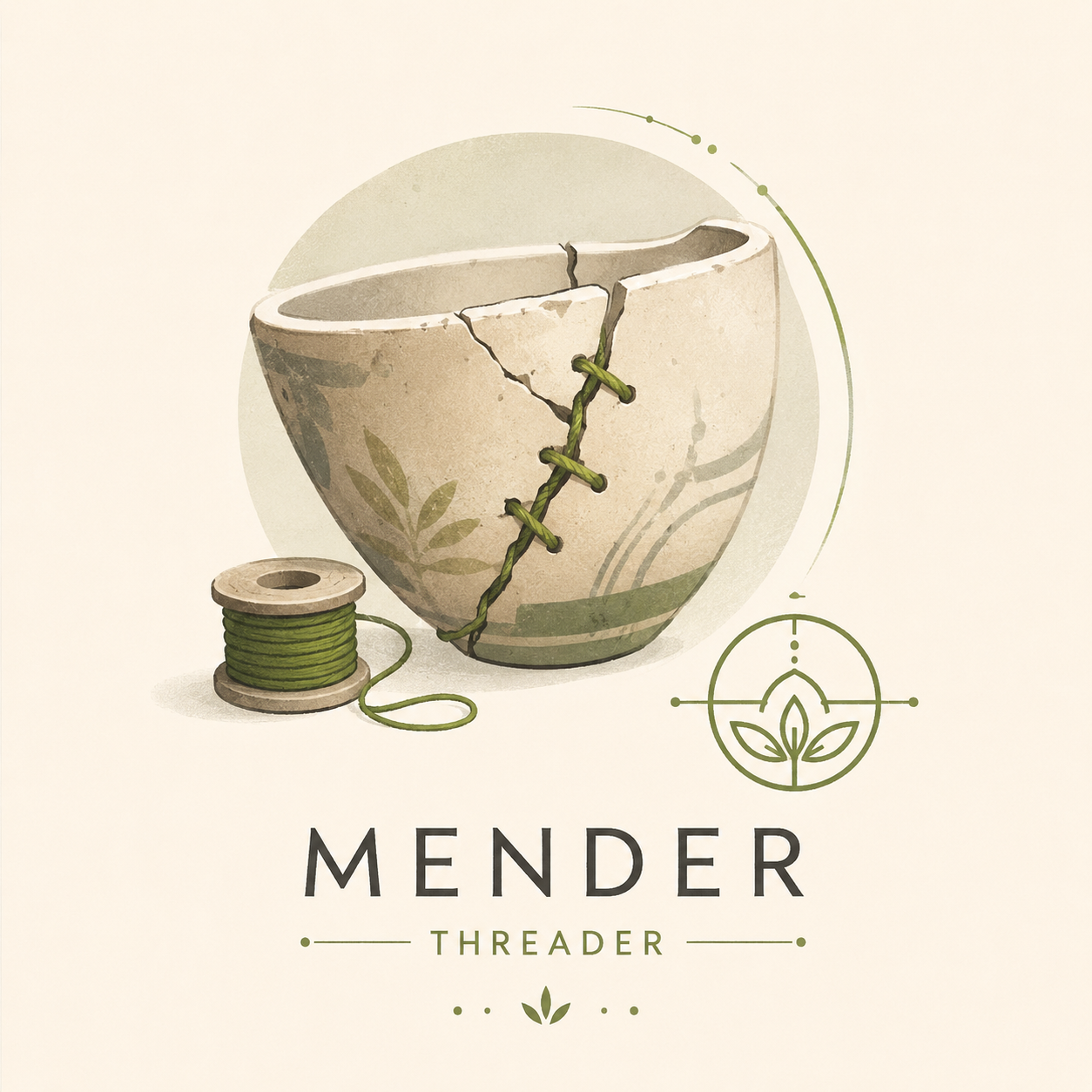
The plate is the simpler public mark. The card is the expanded mythic manifestation. Together, they suggest the same pattern: a break that is neither hidden nor worshiped, but worked with until it can carry life again.
Where This Archetype Appears
Section titled “Where This Archetype Appears”- The craftsperson who restores a beloved object instead of replacing it.
- The bodyworker, physical therapist, or traditional healer who works through touch, feedback, and patience.
- The elder who knows which small repair keeps a house, tool, or relationship usable.
- The story role who stays after the dramatic scene and makes continuation possible.
- The healer-restorer figure in folklore: cloth, herbs, binding, careful hands, and a room where the wounded are no longer being watched as a performance.
- The repaired-vessel image, where a fracture becomes part of the object’s trustworthy form rather than something erased.
Story Echoes, Not Typings
Section titled “Story Echoes, Not Typings”These are candidate echoes. They are not claims that any character, story, tradition, or person “is” Mender.
- The healer’s staff: repair as craft and obligation, not spectacle.
- Kintsugi-like repaired vessels: damage worked into a stronger visible form.
- The village healer or field medic: the one who remains when the action moves elsewhere.
- The restorer’s workshop: a place where broken objects are handled with enough respect to become usable again.
Where It Expands
Section titled “Where It Expands”Mender expands when there is time to notice. It thrives where the damage is real but not disposable, where tactile feedback matters, and where trust allows the work to proceed without a crowd demanding proof at every second.
It also expands around continuity. This archetype is strongest when repair is allowed to be relational: return visits, accumulated knowledge, gradual adjustment, a fix that can be tested and strengthened.
Mender does not need the grand stage. It needs a repairable thing, a consenting person or place, honest feedback, and the room to do careful work.
Where It Constricts
Section titled “Where It Constricts”Mender constricts when speed becomes the only measure of value. Forced urgency can flatten its gifts into patchwork: fix it fast, make it look fine, hide the fracture, move on.
It also constricts under over-responsibility. The Mender may try to repair what should be released, carry damage that belongs to a whole system, or accept endless breakage without the conditions needed for recovery.
The shadow is repair without consent: touching what has not been offered, fixing as control, or treating someone else’s wound as proof of one’s usefulness. The mature Mender knows that not every break is an invitation, and not every repair is theirs to make.
Nearby Archetypes
Section titled “Nearby Archetypes”Steady-Hand Mender, the high-stakes precision mender, is nearby when repair becomes acute and exact: the cut must be clean, the hand must not shake, and the stakes are immediate.
Triage-Mind, the urgent sorter, is nearby when the first task is triage: what needs attention first, what can wait, and what must be stabilized before deeper repair can begin.
Mender is quieter than both. It lives in the long after: the patient adjustment, the healing table, the restored tool, the fracture that can finally bear weight again.